


In 2006, a group of medical researchers designed a study evaluating the effects of prayer on patients following cardiac bypass surgery. The study (unsurprisingly) showed that prayer had no effects on medical outcomes, except for those who knew they were being prayed for—they had more complications than those who were not informed (likely due to the anxiety of knowing that the researchers had essentially placed a bet for believers on the speed of their recovery). Of course, Christians have a laundry list of reasons why the study did not prove what they had hoped it would, but as a test of the potential reality of the supernatural, it was a clear failure. Subsequent studies on the effects of prayer on mental health have yielded a mix of positive and negative results.
‘Prayer’ for these purposes describes a broad range of phenomenon, from confessing sins to offering gratitude, with requests for answers, actions, or objects, mixed in. The benefits or prayer are primarily psychological, and fairly intuitive. Prayer can allow distancing from an emotionally charged situation and can increase focus. It can also lead to more thoughtful decision-making in certain situations. It can accentuate feelings of love towards others. Yet something many believers are disinclined to admit--prayer also carries psychological risks. Confessional prayer can actually increase anxiety and lead to compulsion. Prayer can replace altruistic action when the person praying decides that prayer will be of more value than a donation of time or money. For those requesting divine answers or action, it can skew their perception of reality when those actions or answers do not follow, or conversely, when they project meaning on to entirely coincidental events. Regardless of whether the effects are positive or negative for any individual, the greatest downside of prayer is its attachment to the supernatural—prayer requires a wish-granting invisible being(s) to be prayed to, and this being must first be subconsciously projected by the imagination. For multitudes of religious people, prayer is a highly reinforcing mechanism of the indoctrination cycle, helping to train their brains to see the imagined hands of invisible spiritual beings in completely ordinary events.
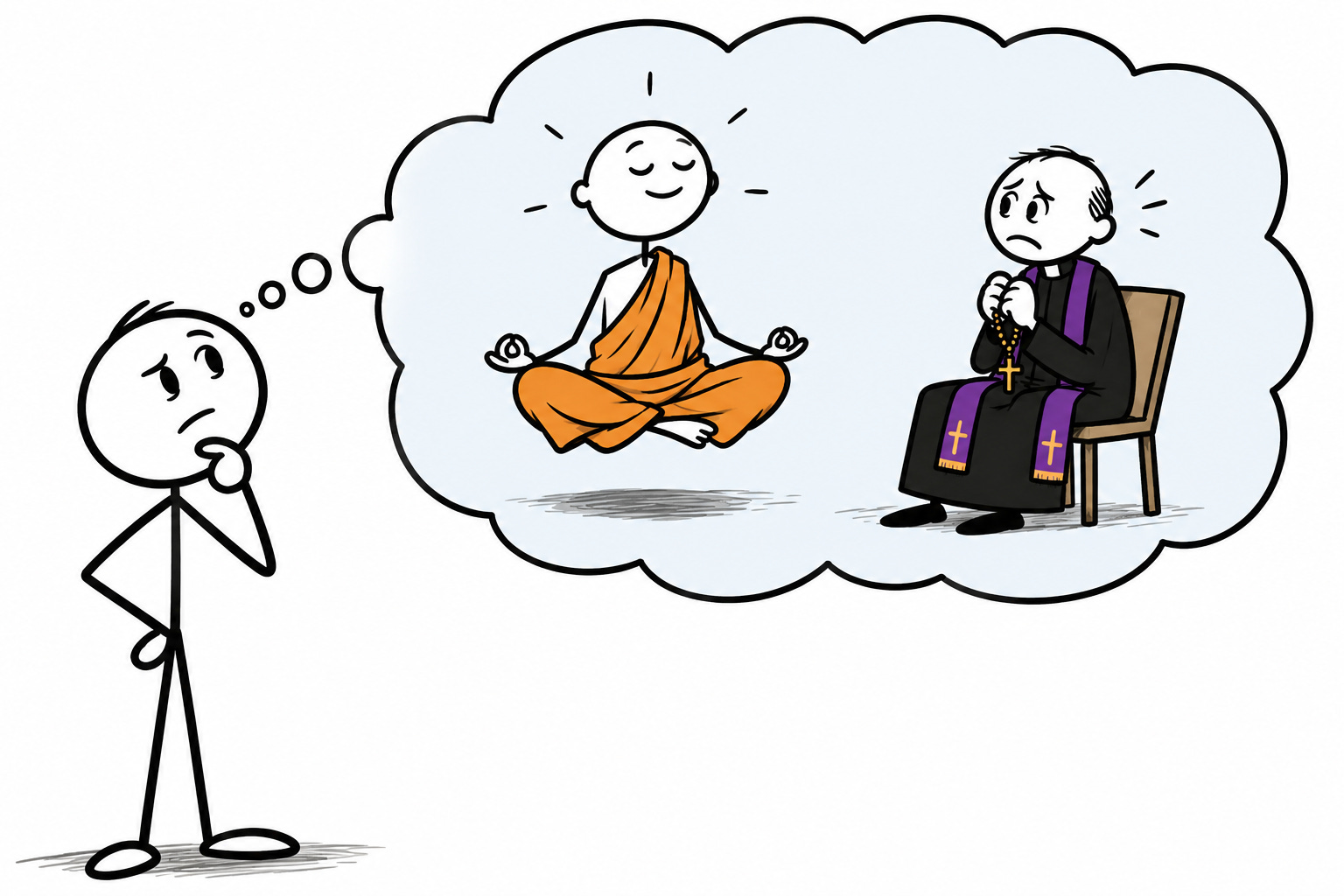
Meditation can offer all of the positives of prayer without the requirement of an imagined deity and without any of the potential downsides or risks. It has a robust literature that supports its physiological and psychological benefits, which overlap completely with those of prayer. Meditation often carries the baggage of New Ageism or Eastern mysticism, with imagery of a Zen master floating cross-legged through life, however, from a practical standpoint, it is nothing more than a cognitive exercise that can improve well-being and enhance emotional control. It is best thought of as practice--but practice that will never reach perfection. In fact, there is no formal end goal, but meditation practice can move from discreet pockets of time taken out of one’s day, to become one’s normal conscious state. Thus ‘practice’ is akin to training for real life.
And what is that we are meant to practice? Meditation in its simplest form is nothing more than directing our attention.
Given its extensive history, there are numerous names and methods of meditation across the world, but for our purposes, we will limit this topic to two: ‘Mindfulness’ and ‘Metta.’ Mindfulness is a focus of the attention on the here and now. The goal is to actively discard the endless river of chatter in our brains and identify precisely what it is we are experiencing, while we experience it. In this way, mindfulness meditation has the potential psychological byproduct of keeping us from fixating on future worries or past regrets, and with practice, it can allow us to recognize distressing emotional states in the moment in order to let go of them more quickly and easily. Any of the senses, especially sight, sound, and touch, can be utilized for mindfulness, and it is common to switch from one to the other at the start of, or even during, meditative practice. Continuously directing attention to your visual field with eyes closed is common, as is directing attention to the physical sensation of touch at the tips of your opposed fingers. Regardless of the sensory modality used, mindfulness can teach us to recognize what it is that we are feeling, while we feel it—to tap into and remain in, the immediately available stream of Now. Like ‘meditation,’ ‘mindfulness’ is often a loaded term in our culture, but stripped away of all of the magical qualities projected on to it, it is arguably the most useful way to approach conscious awareness day to day and the best way to get the most out of any given experience. Practicing mindfulness can decrease stress, anxiety, and pain, and it has actually become an element of many forms of psychotherapy offered in the mental health space.
Metta is the focus of the attention on feelings of love and good intention towards oneself and toward others. It too can reduce stress, as well as increase positive feelings and prosocial behaviors. Both of these forms of meditation are available at any time, and both are excellent replacements for prayer for those with a religious past or who are interested in replacing the parts of their belief system that they remain attached to. There is nothing embarrassing about missing the act of prayer, especially if it was part of your routine. And there is no reason that it cannot be easily replaced with something more beneficial. I personally like to envision meditation as a replacement for church, where likeminded people get together and spend time in Metta meditation. (I can have dreams, can’t I?)
Breath counting is the most basic technique for mindfulness and is the usual entry point for those interested in starting a practice. It is shockingly difficult to quiet the mind if you’ve never attempted to before. The method asks you to focus your attention on each breath, from start to finish, counting each, from one to four (or one to ten), and then repeating this process for a period of time. The time can vary from one minute, to five minutes, to ten, a half hour, an hour or even more for those with experience. The focus itself can be aimed at the sensation of the breath at the nostrils, at the feeling of the rising and falling of the diaphragm, at the sound of the air entering and exiting the body—any of the multiple sensations that accompany breathing that we normally tune out. This meditation may seem simple, but once started, you quickly become aware of all of the directions your brain will pull you and all of the random thoughts you will suddenly be bombarded with. One. Two…what was it I was supposed to remember to pick up at the store? No, let’s restart: One. Two. Three…is this just a waste of time, why am I sitting here when I could be catching up on emails? They say it’s good for me, I’ll keep going: Four. One. Two. Three…I have that work meeting next week that I need to make the presentation for. I can’t believe I got stuck doing this when it’s not even in my department. I’m fed up with the way she runs her whole team! Should I leave my job? Wait, why am I sitting here again. Shit, okay, let’s try again: One…dammit, I left the yogurt out: One. Two. Three. Four. One. Two. Three. Four. One…Wait a minute, I’m doing it!—I’m actually meditating! That wasn’t so hard, it only took a few tries and I got it, I guess it’s easier than they say. But then, is thinking about breath counting actually breath counting?… God dammit: One. Two. Three…
One of the most fascinating things about the experience of meditation is the countless ways your brain will try and distract you. Even after years of practice it can surprise you.
For beginners, the best way to get started with a guided practice is to take advantage of the widespread online availability of information and apps. The VA has a pretty good guide and resource list for those interested in learning more. In addition, there are several apps that offer guided meditations. The Waking Up app is the best paid app IMO, available for 130$ per year. It is the one I use for my own practice. For those not ready to spend money, Insight Timer has an excellent free meditation app. The Muse app offers a free version for use with its headband, which creates visual and audio feedback, allowing you to see in real time the effect of sustained focus on your brain. The cost runs in the 300-600$ range, so potentially fairly pricey, especially for beginners. I used one of its earlier iterations years ago and found it very cool. I have no financial relationship with any of these apps or companies—I’m simply a huge fan of meditation for everyone and I know that different avenues work for different peeps.
For those escaping a faith-based worldview, the brain is going to be immediately looking for replacements for whatever it received from that worldview, both good and bad, because that is what was familiar. The time period immediately after a worldview shatters can be distressing and overwhelming and leave us vulnerable to slip from one magical way of thinking into another. While meditation is a great alternative for prayer, there is no reason for any given meditation practice not to be grounded in psychology and actual science, so be wary of anyone offering promises of the supernatural, even if they sound non-religious. One of the most rewarding potential experiences of meditation is the glimpses of insight it offers into the illusions of the self and of mind-body duality. Understanding each of these can alter your perspective of reality in exciting ways. This will be covered in upcoming essays on meditation.
For those who already have a meditation practice, feel free to share your experience and any resources you might use that you find particularly helpful. For anyone else, please reach out with any questions.