


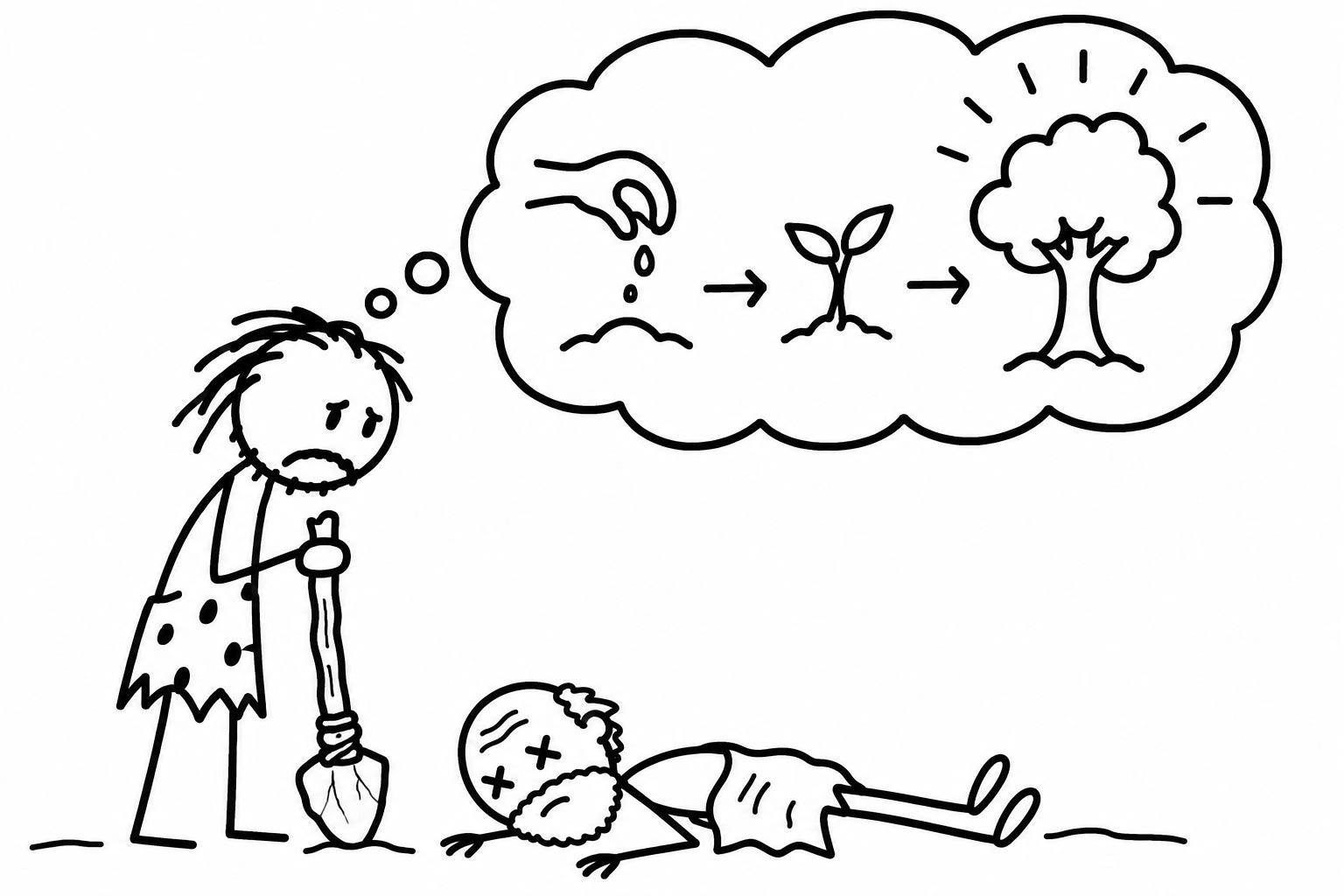
Since the earliest days of conscious self-awareness hundreds of thousands(ish) of years ago, humans have carried in our brains, imagined, magical beings and forces that we have projected onto the world. The particular characteristics of these invisible entities have been unique to our cultures and geographies, but they all owe their existences to our imaginations within the framework of a supernatural worldview. In looking back to our homo erectus and sapiens ancestors, it is not difficult to understand how supernatural concepts developed as a psychological response to the terror of life during the period of emerging self-awareness. When avoiding predators and scavenging daily calories were the primary goals of existence, an abstract understanding of the mechanics of nature was not high on the list of the subconscious brain’s cognitive priorities. Instead, the pattern-seeking and anthropomorphizing brains of our ancestors adapted imagined beings into reality to provide proximate causes to the endless list of effects they encountered: sunrises, sunsets, moon phases, eclipses, stars, rain, storms, thunder, lightning, clouds, fog, floods, drought, rainbows, fire, plant life from seeds, plant death, life from eggs, life from other life, insects bites, poisonous animals, infections, illness, dreams, nightmares, death-- almost every conceivable experience could have been a source of confusion and anxiety when conscious self-awareness came into being. It has been argued that there was an adaptive evolutionary benefit for humans in attributing these unknown forces to the actions of an imagined, magical being that had human characteristics and could be visualized and described to others. (Personally, I think the question yet remains as to its ultimate benefit. If we manage to extinguish ourselves in a holy war, that argument dies with humanity). Subsequently, these imagined beings have monopolized the worldviews of every human culture known, at least up until a few hundred years ago.
With the scientific revolution in the 17th century arose the beginnings of an alternative approach to understanding reality that no longer required pretending. This alternative approach has become the most significant force of change in the history of mankind. A scientific understanding of weather patterns upon crop production consistently leads to better harvests than when yearly sacrifices were made to appease the gods. The understanding of medicine allows for cures of diseases once attributed to evil spirits. Humans can now routinely travel from one side of the world to the other in a matter of hours instead of months or years, all the while living longer, more comfortable lives. Each of these positive outcomes, and countless more, are the result of human brains acquiring and utilizing a scientific understanding of the world. Because of its predictive advantage and ability to produce these desirable outcomes, science has allowed humans a pathway away from magical thinking and towards an evidence-based, naturalistic worldview. This is objectively and demonstrably the most useful way to approach reality, to assess risk, and to understand the world around us. A naturalist worldview added boundaries that helped define what could and could not be real, based on sensory input and experimental evidence. It immediately began to undermine the value of appealing to unseen entities for explanation. In addition to this reliance on observations and interpretations of the actual physical world using evidence and reason, the naturalist worldview is also, very importantly, updateable. Indeed, the adaptability to incorporate new information and change existing paradigms is one of the reasons that science has been so successful in its explanations of the universe. A new theory that appears to contradict a previously accepted theory follows the scientific process of experimentation and further observation. If needs be, a long-held scientific model can and will be discarded for a newer model that is more reproducible or that offers a better explanation of experimental evidence. The naturalist worldview has made possible an understanding of the world to a degree never before imagined, but despite the acceptance of the results of this worldview in terms of technological advancements and increasing comfort in day-to-day life, a huge percentage of the world’s population have been unable to fully endorse the underlying naturalist worldview that made these things possible. This is primarily the result of religious indoctrination but can also develop due to simple exposure to, and tacit approval of, the validity of the supernatural by the adults involved in one’s development—even if they are not devoutly religious.
Thus, the supernatural worldview in its many iterations remains the reality-processing software for billions of humans alive today. In the US, the supernatural worldview accepted by the majority of citizens is Christianity, in one of its many variations. Given the complete lack of sensory evidence for the unseen magical beings of Christianity, maintaining this supernatural worldview requires that the cognitive processes associated with reality testing are functioning in a less optimal manner than they could and should. In fact, as it exists today, the supernatural Christian worldview remains highly flawed in its evaluation of information and perception of risk. The cognitive shortcuts and psychological errors that allow the Christian worldview to be taken seriously by society in a modern age also make it detrimental to progress.
In contrast to the natural worldview, the supernatural worldview continues to project the unreal on to the real as it deals with new information. The naturalistic explanatory powers of observation plus reason, which are necessarily downplayed in the supernatural worldview, are superseded by and replaced with, feelings, imagination, and “revealed truth.” The first two are mental processes that ordinarily serve very important cognitive functions for the conscious brain. Their importance can subconsciously be given too much weight however, and they can become unbounded by rationality. This leads to their maladaptive use to maintain a supernatural worldview. The essence of revealed truth is the normalized acceptance that communication can and does exist between invisible beings and humans, and that invisible beings operate in unseen ways in the physical world. This belief shapes the supernatural worldview framework and directly affects how Christians perceive reality and risk. The three of these processes collectively—routine overreliance on emotion, sustained conflation of imagination with reality, and the acceptance of revealed truth as evidence—comprise the modern adaptation of the prehistoric supernatural worldview. The invisible forces have different names and intentions, but they are still the product of the imagination, reinforced by emotion and indoctrination. This requirement to view the world through the supernatural lens results in a distorted view of reality, the result of the brain’s inability to appropriately critically evaluate the natural world and its associated risks. If a parent were given an option to protect their children from online scams, conspiracy thinking, cult environments, etc., they would, no doubt, choose to do so. Ironically, the fact that they fail to see that religious indoctrination itself increases the susceptibility to these malicious events is further evidence of the dangers of the supernatural worldview to which they cling. Leaving behind the illusions of comfort offered by the supernatural can be difficult, especially in an overtly religious society, however, understanding reality without having to rely on the mental projections of our imaginations is a far more fulfilling way to be, in the universe.
As always, I am interested in the perspectives of those who have escaped faith or who somehow avoided it altogether. Thanks for the follows, subscriptions, DMs and support!