


In the latest escapade of human brilliance, AI companies are trying to convince AI not to kill us all by training the models in morality. To this end, they are apparently consulting with various religious leaders of different traditions. There is a reason that ‘Holy War’ is part of our common vernacular. The idea that any humans, let alone those of opposing faiths, could agree on something as nebulous as ‘morality’ seems as preposterous as the idea that we could teach it to non-human entities.

What we should be able to agree on is the active avoidance of anything remotely suggestive of gods or the supernatural when dealing with AI. It occurred to me that the use of the Bible as a training tool for AI may be the single best argument against those that consider it the ‘foundational source of morality.’ Yahweh’s body count in the Old Testament is astronomical, and in the account of the Flood—arguably his most vindictive act—was limited only by the number of his human generations that had had a chance to reproduce since he created them. He literally killed them all (minus the few he liked). And when the 10 commandments are overlaid on all the carnage, there is a very clear message of: Do as I say, not as I do.
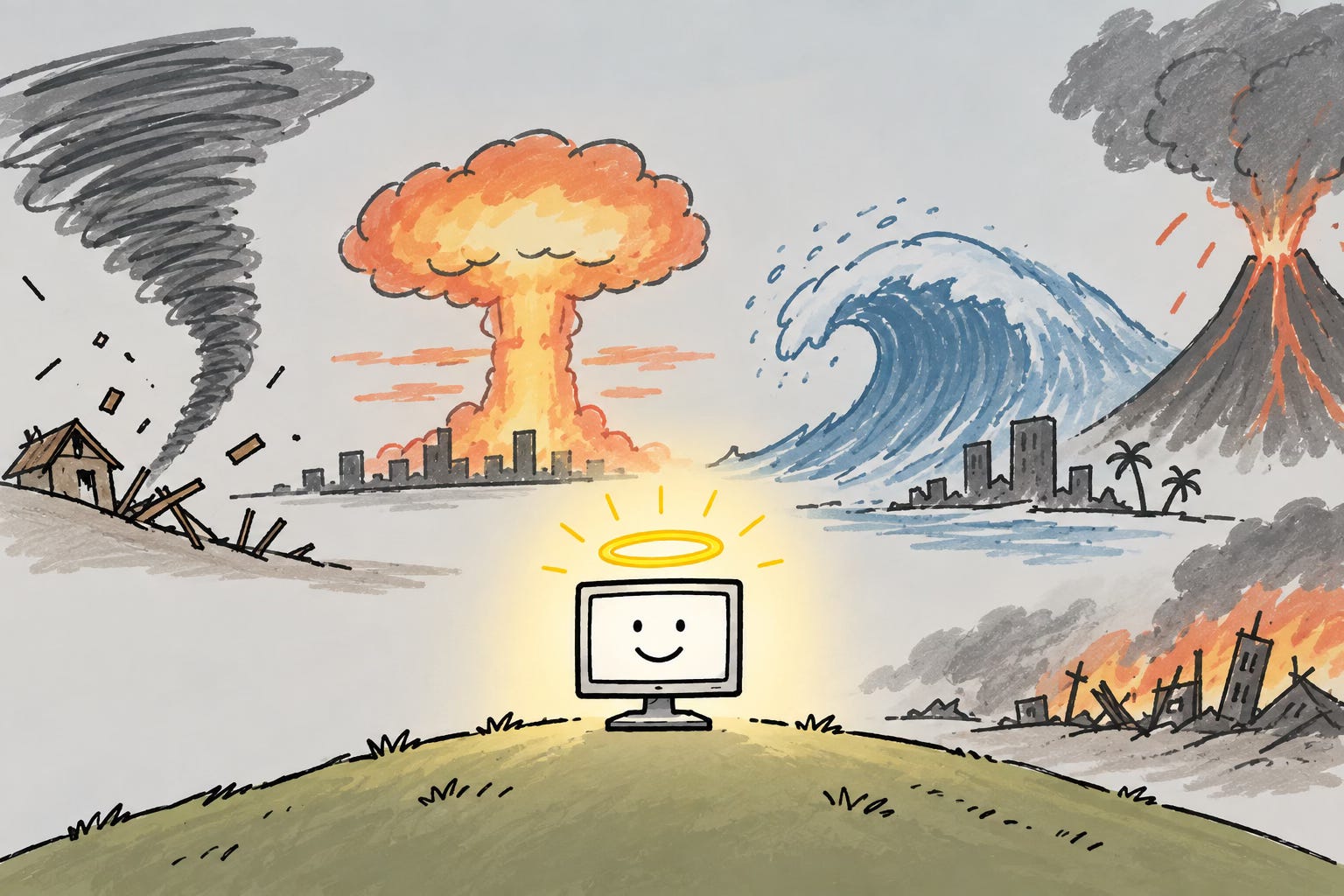
The existence of advocates for Divine Command theory and Revealed Truth in a modern era is evidence of failed critical thinking. The inclusion of their input into what may be the most consequential human endeavor in history is sadly the next step in that failure. If religion is the thing that is supposed to keep us safe from our AI overlords, god help us all. (Of course, pun intended—this is faith-free future after all.)
For those interested in the topic of morality, I recommend reading fellow Substacker Graham Lapworth’s posts. He makes a pretty compelling case that ‘morality’ is not even real. This is an unsolicited plug—I find his work answers a lot of questions I’ve had since leaving Christianity and want to share his ideas.