


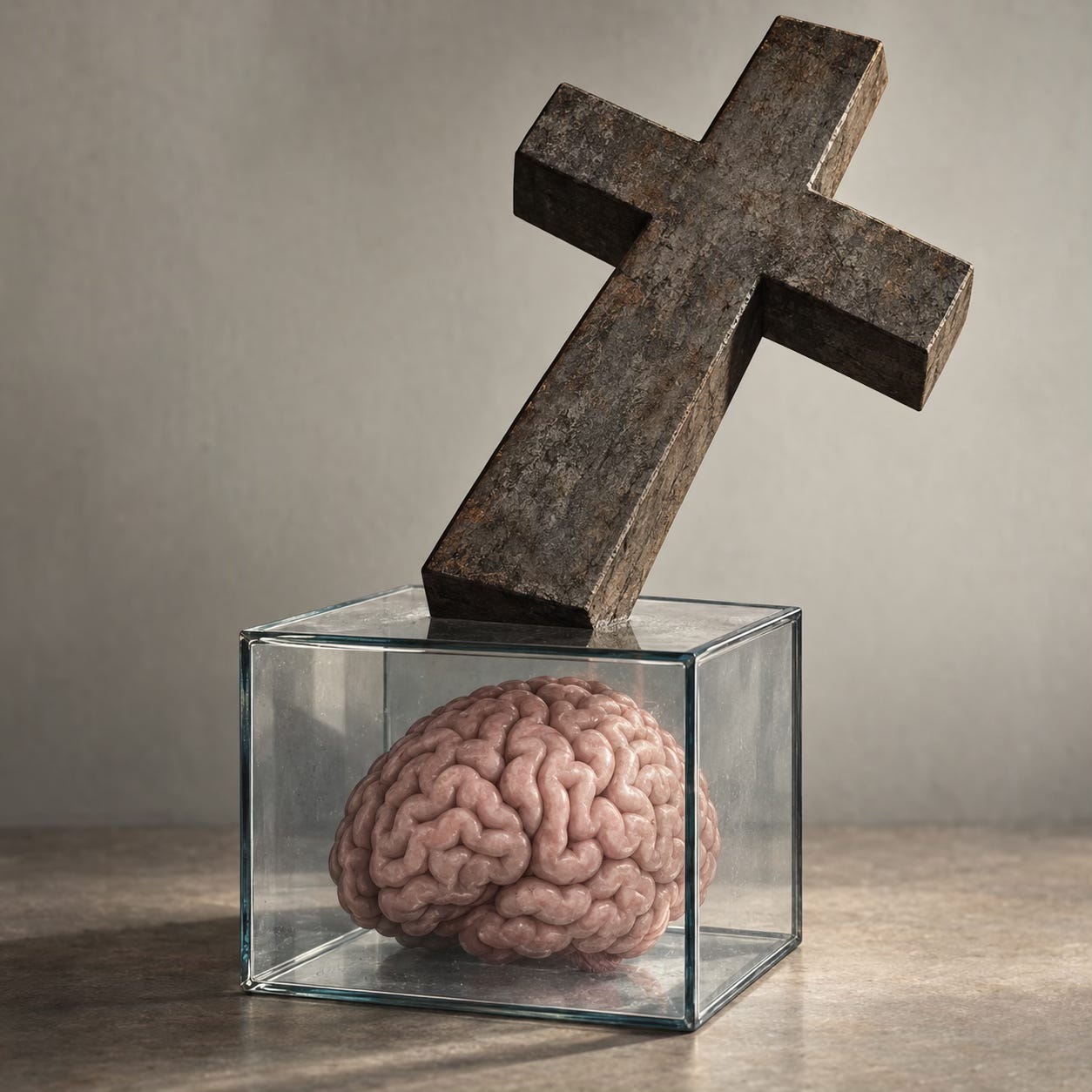
If you’ve ever had doubts about Christianity,
That is your brain trying to reach you through the noise of indoctrination.
That is your brain showing you that it still works the way it’s supposed to.
That is the seeds of Critical Thinking.
Don’t ignore those doubts!
So many of us have escaped our belief systems and found reality.
You can too.
Exactly so. Doubt is not weakness, hesitation, or fear. It is your subconscious telling you it cannot join the dots with the information available. Doubt is a request for more data.
People treat doubt as an emotional wobble. It isn’t.
It’s a structural signal.
Your subconscious runs pattern‑recognition in the background. When the pattern doesn’t resolve — when the inputs don’t cohere — it sends a prompt: stop, something is missing. That’s doubt.
There is no need for rash choices.
No need for forced certainty.
No need to “trust your gut” in the mystical sense.
Just gather more information, but gather it outside the echo chambers that exist everywhere. Quality matters. Noise doesn’t resolve doubt; it amplifies it.
When the subconscious can finally join the dots, doubt disappears.
Clarity replaces it.
Hope this helps.
Daniel, an after thought. Perhaps setting a baseline for how I use the terms ethics, empathy and morality in my theory. That gives us a clear starting point, and then you can guide the conversation wherever you wish.
Ethics, in the descriptive sense, does not tell you what is good; it tells you what follows from what. If I want X as an outcome, I must accomplish Y. No guarantees — just a rational causal chain. Then comes the question of whether I should do Y, which is still pre‑moral: harm minimisation, reciprocity, prudence. Ethics predates morality.
Morality, I do not define. I use the only definition that matters — the one its creators used: a collection of rules, concepts and ideologies conflated under one umbrella. I acknowledge the subsequent changes, but as changes. As I put it recently: a rose by any other name is still a rose, but a poppy is not a rose. The name does not change the ontology or its history. We recognise a rose even when its colour or scent is altered; we do not deny its lineage. Yet with morality, people treat every later addition as if it were the original thing. This is the issue I deal with.
Empathy is where I diverge from the mainstream. Many treat it as a virtue, a moral trait, an identity. I reject all of that. Not because people don’t behave this way, but because they are misdiagnosing the mechanism and harming themselves by doing so. Empathy, in my model, is simple: it is a data‑collection system. We register our surroundings — people included — and the subconscious filters and analyses those inputs. That is where empathy ends.
The downstream categories — fear, sympathy, compassion, anger — are separate. They exist or don’t, independently and to varying degrees. This explains why narcissists read people so well: they have strong empathic registration but no downstream compassion.
It also explains the harm done to the so‑called empath, of which I considered myself one — at great cost. They conflate empathy with compassion and build an identity around it. Society praises them for giving until nothing remains, and narcissists exploit that. A balanced person values their time and knows when to say no. A diamond and dirt both have value: one gives us life and sustenance for free, the other is rare and gives little but is praised. Be neither; find the middle. Empathy does not command compassion. Understanding this protects the very people who most need protecting.
This leads to what I call Empathic Ethics: Data collection → emotional assessment → ethical objective → empathic compassion toward the other → conclusion that is ethical and compassionate toward self, tribe and the other. The aim is to minimise tribalism and unchecked self‑interest.
That’s the baseline. From here, take the conversation wherever you wish.
I have a few questions for you too. : )