


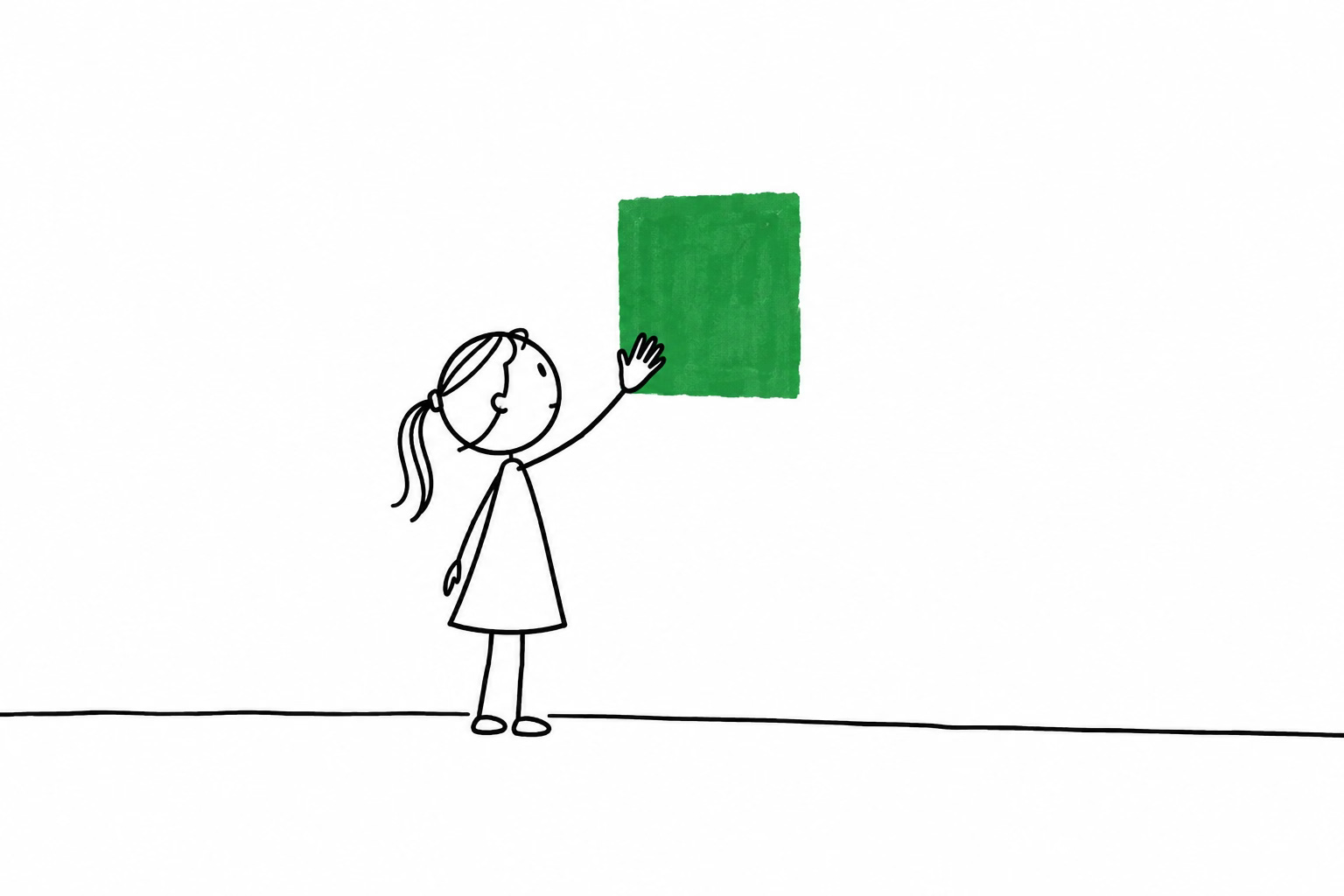
Please join me on a thought experiment journey. Imagine that a small child, Mia, is taught that touching a green section of the wall of her home will help her feel better. In her room, as in each room in the house, there is a single square-foot box, painted pine green, around waist high. All during childhood, she sees her parents touch one of these green boxes throughout the house any time they are distressed, and they appear to feel better afterwards. Any time there is a financial issue, or work stress, or a major decision to make, they touch the green box. From her earliest memories, Mia’s parents encouraged her to touch the green box when she was upset, and then they would say things like: ‘there, now, don’t you feel better?’ and ‘aren’t we lucky to have the green box.’ In addition to her experience at home, she weekly joins her parents at meetings that include other people that talk about the green box. During these meetings, a man that her parents trust stands before the group and talks about the comfort the green box can provide if one simply believes it. He talks about how special they are to have been allowed to have the box, and how other groups in the world that use orange, blue, or yellow boxes are all wrong, and that they do not receive actual comfort—even if they think they do. During these meetings, they read from a book that describes the use of the green box by people from thousands of years ago. The members of Mia’s group all have their own stories from their lives and can describe times when they received relief by touching the green boxes in their own homes. On occasion during these meetings, a participant will suggest that the green box had not provided relief from a recent distressing event. The answers are immediate and all converge upon the same pronouncement, which is ultimately reiterated by the leader: if you are not feeling relief after touching the green box, you are not believing strongly enough—the problem is not the green box, it’s you. Most of these questioners return the following week proclaiming how they managed to believe more strongly and were once again receiving the promised comfort.
For young Mia, touching the green box becomes a daily routine, and she eventually develops a habit of touching the box multiple times per day. There are particularly stressful days when she devotes a great deal of time to touching the green box, and other, more care-free days that she might only need to touch it once or twice. A few times in her life—during tragedies or major life calamities, she has set a chair next to the box in her room so that she can remain in near constant contact with it. In addition, regardless of the level of stress, she also begins each morning and ends each day with the action of touching the box. This is something she came up with on her own, as it is not described in the book, but she is convinced that it helps her days go a little better, and no one has discouraged her from doing this when she shared the idea at the group meeting. In fact, many others admit to doing the same.
This pattern of behavior follows her into adulthood. Now in her 30s, her home, of course, is decorated by numerous green boxes, at least one per room. When her boyfriend, now her husband, used to tell her it didn’t make sense, she insisted that the experience was real, and she was, in fact, surprised that he had not been raised to touch the green box or even one of the incorrectly colored boxes when he was a child. Trying to be a good partner, but with no previous similar experiences, he tried touching the box when he was stressed on several different occasions, and found that it did nothing for him. She is unsure why it does not work the same way for him, but after consulting with other green box devotees, she has decided that it is because her partner does not believe strongly enough, rather than there being any issues with the box itself or with belief in the box. She wants so badly to be able to prove the truth of the experience of the green box and for him to share in its comfort, but, sadly, there is no way she can do this except to point to the experiences of herself and all of the green box followers she knows. For Mia, imagining a life with no green box is terrifying, and she is grateful for being lucky enough to have been born into a family that had found the green box, rather than another colored box or, even worse, no box at all.
Sadly, the story ends when the group Mia belongs to learns that they have incorrectly read the ancient book about the green box, and the shade was not actually ‘pine,’ but ‘lime’ green. This was apparently an easy mistake to make, as the book had been translated multiple times from the original language, and some of the original words had different meanings to different people throughout history. She spent some months arguing the merit of the lime, rather than the pine green, to whoever of her former friends or her family would listen, but she eventually questioned the new interpretation and currently has decided that she no longer needs her group or family in order to find comfort from the green box. Which is actually a good thing, as she is currently not talking to her family at the time of the end of this thought experiment due to the dispute over shade of green.)
What is happening with Mia and what happened with so many former religious believers like myself can be explained by Pavlovian conditioning (that’s the one where the dog salivates when it hears the bell) early in development. Mia’s brain has been trained through conditioning to briefly feel less anxious when performing a particular action that she was taught to perform, and that was modeled for her, even though there is nothing special about the green box or the act of touching it. The same can be said for prayer, confession, reading the Bible, daily devotions, or any of the other frequently performed rituals performed by the believers in monotheistic religions. Each of these individual acts falls under the umbrella of ‘faith’ and produces a temporary illusion of comfort. A highly active imagination and stronger bond with one’s religious community increase the likelihood of the conditioning taking hold and of one’s worldview becoming entirely ‘faith-based’ or supernatural. Once implanted, the supernatural is usually there for good. So is the case for the vast majority of humans since the beginning of their attempts to understand the cosmos.
Taking the conditioning concept a step further in relation to the psychology of the comfort illusions of faith, the entire process involves something similar to the compulsions of obsessive-compulsive disorder (more often referred to by its acronym, OCD) which temporarily and briefly alleviate immediate worry, but do nothing to treat the underlying anxiety. In the case of religious worldviews, the anxiety is itself created by the religion as the premise for why we need that same religion for comfort: we are born evil or separated from god, and, without faith, will suffer terribly. Christopher Hitchens said it brilliantly: “we are created sick and commanded to be well.” As mentioned earlier, the imagination is also highjacked during development in order to convince young believers that there are actually invisible spiritual beings that are doing the comforting, going so far as to refer to Jesus as a best friend, but that is for another essay. Thus day to day life can become a roller coaster of ups and downs: anxiety, distress, guilt, shame, fear—punctuated by brief periods of relief following confession or prayer. However, whatever comfort prayer brings, it wears off quickly, and the cycle inevitably continues. If prayer actually worked, there would be no need to ever pray more than once; and there would be no such thing as doubt if belief truly described reality.
Based upon my own experience and that of many former believers with whom I have interacted, the cycle of indoctrination during development does the majority of the heavy lifting for the creation of the ‘experience of Christianity’ that Christians point to as validation of their faith when their rational arguments inevitably hit a wall. Reinforcement of the ‘reality’ of this experience during development is accomplished by the work of trusted adults until eventually, mature Christians are able to completely reinforce the reality on their own, projecting their own faith-based interpretation of events onto any aspect of life. Thus, by the end of our story, Mia no longer requires church or family to sustain the illusion and is able to maintain her beliefs entirely on her own—the indoctrination cycle has successfully been completed.
I realize there are many ideas going on at once in this essay. Faith is complex, as is the human brain, and it is impossible to discuss certain aspects discreetly. I hope the analogy served its purpose. As always, thanks for reading. I am very interested in community and in the shared experience of those like myself who have managed to escape belief systems. I encourage you to comment if you have read the Rules of Engagement for Faith-Free Future and have something you would like to contribute, especially if there are other ideas that resonate from the thought experiment. Finally, thanks to so many of you who have my philosophical back in the endless onslaught of responses from believers to what I post in the notes. I’m pretty sure they believe they’re winning brownie points with JC for doing so—I’m sure I would have thought the same--but it gets fairly tiresome, especially as I have no interest in arguing with someone whose mind is still trapped in the supernatural bubble. Until next Sunday, I hope you have a great week.