


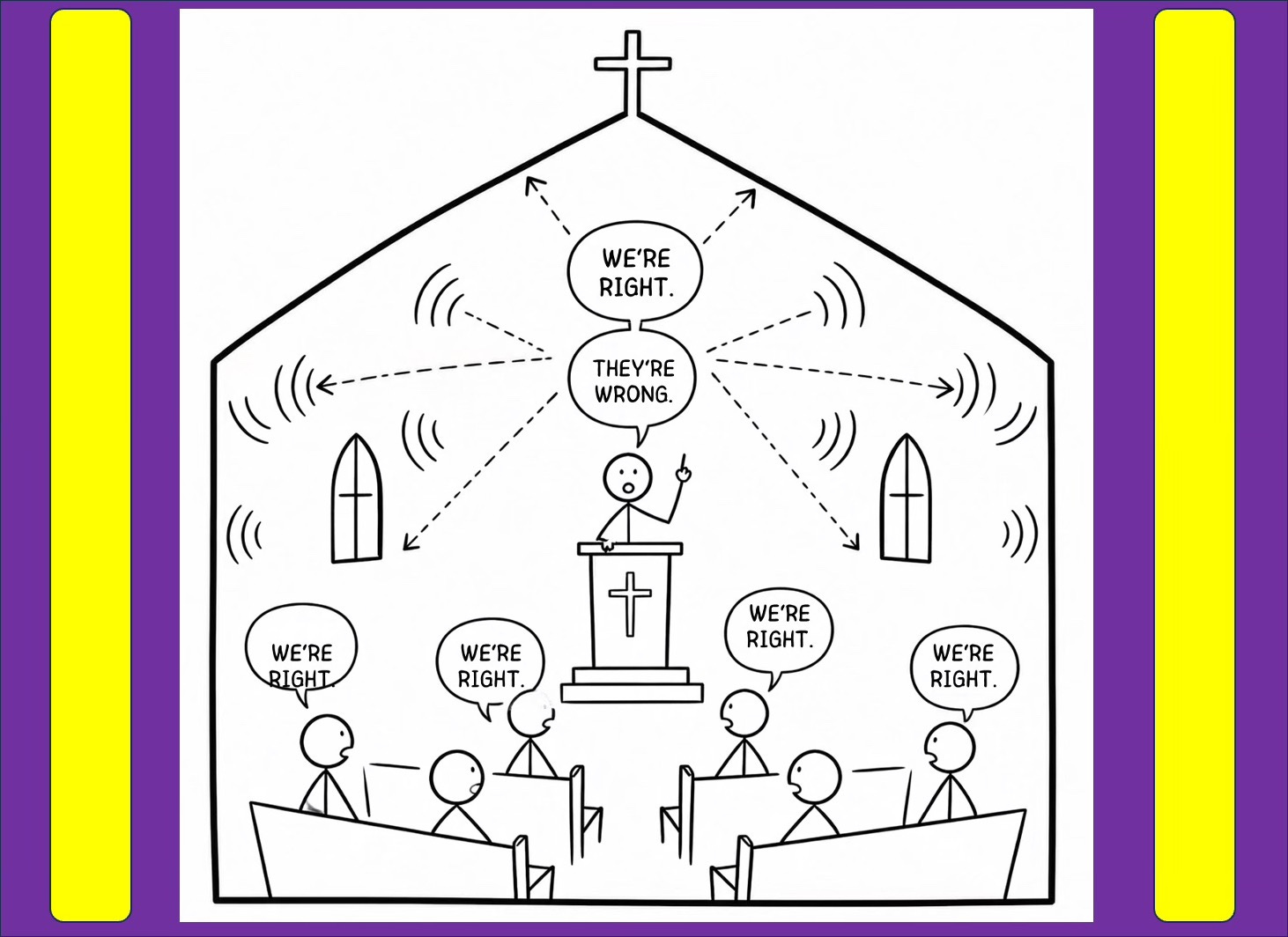
Every week, around one third of well-intentioned Americans put on their Sunday best and head to church. The part Bronze Age / part Roman Era book that they reference in order to properly worship requires significant interpretation, and although Christians theoretically all worship the same deity, differences in interpretation of the texts have led to thousands of brands--the denominations and sects--of Christianity in the US alone, and tens of thousands of brands worldwide. This matter of conflicting interpretations is nothing new for Christians. In fact, a significant percentage of early Americans that helped settle the country crossed the ocean so they could practice their own unique brands that were not accepted in their home countries. (Check out Fantasyland for a fascinating read.) A proper understanding of Christianity must take into account this propensity of its followers to divide into separate, exclusionary groups.
The role of any given Christian church today is arguably to serve two functions. The first of these is to help Christians maintain their faith-based worldview in the face of an increasingly modern world. The explanatory value of the ‘revealed truth’ of faith-based worldviews has arguably shrunk since the Enlightenment as science and reason-based worldviews have proven markedly more successful at making sense of the universe. In fact, many of the core Christian beliefs are at odds with the observable world, i.e. virgin birth, resurrection of the dead, miracles, golden palaces somewhere in the sky. For the individual believer, regular reminders that they are not alone in their beliefs, and regular reinforcement of the need to maintain these beliefs for salvation, helps ensure the survival of Christianity as the foundation of a supernatural worldview.
If the first role of the church serves Christianity as a whole, the second role of a church serves each individual brand. Churches owe their existence to the donations of their attendees in the forms of ‘tithes’ or ‘offerings,’ so each particular brand of church is in competition for the attention and wallets of its attendees. To win this competition, each brand of Christianity posits that its unique interpretation of the Bible is the sole source of truth and that all other brands have in some way missed the mark. Each brand’s particular interpretive differences are upheld as better in some way than any other brand’s, as a means of attracting new church members and providing motivation for the existing members to remain with that particular church. Thus, a sense of superiority regarding one’s own brand is inherent in Christian pluralism and is projected towards all other brands in attitudes ranging from mild disapproval to outright contempt. This exclusionary outlook towards believers of other brands is baked into the practice of Christianity in America, so that the divisions between believers are highlighted, at the cost of potential unity.
This description of the American church sets the stage for the premise of this piece. Each Sunday, 100 million Christians separate into distinct groups and gather in a church of their particular brand in order to hear the consistent repetition of the same underlying presuppositions, doctrines and dogmas, protected from outside influence and from any competing ideas from any other brand of church. Thus, the American church is the prototype echo chamber that characterizes modern American politics as well as the rising tide of online conspiracy thinking. After centuries of divisions of Christian believers into their own unique ideological brands, the concept of separating into in-groups and out-groups based solely on ideas is already normal practice for the average American believer. While the outrage-equals-dollars advertising model of social media is no doubt exacerbating the current political hyper-polarization, the culture of competition for attention and money has had an example to follow since the foundation of our country in the form of the American church.
Imagine a world where good faith arguments occurred—not about specific ideological details of a supernatural worldview—but over the best way to live together, find meaning, resolve conflict, and face the unknown. This is a possibility if those of us who have escaped indoctrination are willing to speak up about the risks associated with belief-without-evidence and to help others understand the very real possibility that their desire for experience of the ‘divine’ need not require unsubstantiated faith in nebulous, invisible beings. We can feel whole, and more importantly, we can feel that we are part of a whole by embracing reality, reason, and love. If you haven’t already, please check out Jim Palmer’s Deconstructionology for some of the best writing I’ve ever come across on these topics in his framework of ‘existential health.’ I don’t personally know Jim and only recently discovered his work, but he’s an exceptional writer and thinker, and as a former pastor, he shares insights into this world that are unparalleled IMO.
For the several that joined FFF in the past few weeks, thank you so much for your time and attention. I am genuinely interested in the experiences of others regarding journeys into and out of faith, as well as the world to be imagined post-religion. Always feel free to comment or message me.
It is certainly true religions have their disagreements and there are churches that are toxic echo chambers. Although I think you can find meeting places of atheists where the same is true. There are different brands and different levels of atheism as well from people that are strict material reductionists to those who accept some version of panpsychism. It can also lead you to some really gross beliefs if you aren't careful. Sam Harris doesn't base his racism on his atheism, but I have no doubt he approaches both subjects the same way (in what he sees) as a rational clear emotionless acceptance of reality as it is stripped of bias and personal feeling. Yet there is no view from nowhere.